|
 Gen info Gen info
- Pogostemon is a large genus from the family Lamiaceae, first described as a genus in 1815.
Botany
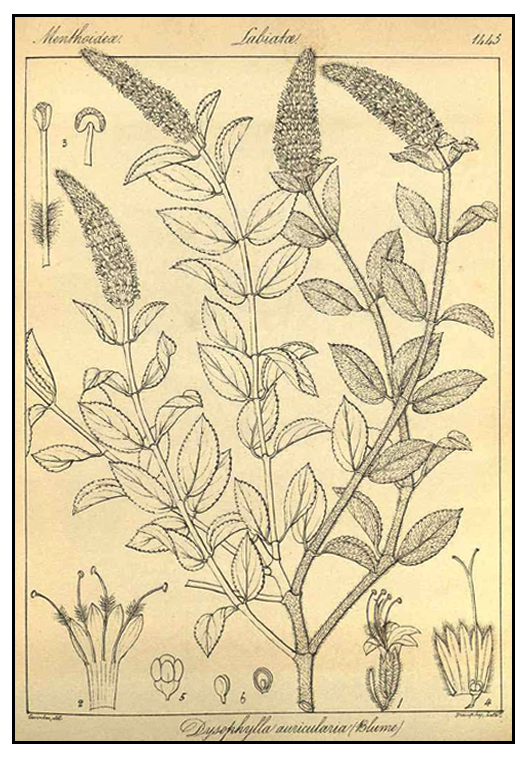
• Buntot pusa is an annual, hairy herb, 30 to 60 centimeters in
height. Leaves are oblong, 2.5 to 7.5 centimeters long, stalkless or short-stalked,
and acute of blunt at the tip. Flowers are small, borne in whorls or
hairy spikes. Calyx is very small, 5 to 7 millimeters long, with triangular teeth; enlarging
to a fruit. Corolla is usually pink, with a slender tube and hairy lobes. Nutlets
are ellipsoid and smooth.
• Herbs annual. Stems 0.4-2 m tall, prostrate basally, rooting at nodes, ascending, apex much branched, densely yellow spreading hirsute. Petiole rarely to 1.2 cm, upper stem leaves subsessile; leaf blade oblong to ovate-oblong, 2.5-7 × 1.5-2.5 cm, yellow strigose, with scattered impressed glands, base rounded to shallowly cordate, rarely cuneate, margin serrate, apex obtuse to acute; lateral veins 5- or 6-paired, conspicuous abaxially. Spikes 6-18 cm, apex caudate-acuminate, ca. 1 cm in diam. in flower, continuous or sometimes interrupted at base; bracts ovate-lanceolate, as long as corolla, margin strigose. Calyx campanulate, ca. 1 × 1 mm, glabrous, yellow glandular; teeth broadly triangular, ca. 1/4 as long as calyx tube, margin pilose. Corolla purplish to white, ca. 2.5 × as long as calyx, glabrous. Stamens much exserted, exserted parts bearded. Nutlets brown, subglobose, ca. 0.5 mm in diam., glabrous. (Flora of China)
Distribution
- Native to the Philippines.
-
Abundant in open, wet places at low and
medium altitudes from northern Luzon to Palawan and Mindanao.
- Also native to Andaman Is., Assam, Bangladesh, Borneo, Cambodia, China South-Central, China Southeast,East Himalaya, Hainan, India, Jawa, Laos, Malaya, Maluku, Myanmar, Nepal, New Guinea, Nicobar Is., Sri Lanka, Sulawesi, Sumatera, Taiwan, Thailand, Vietnam.
 Constituents Constituents
- Aerial parts of P. auricularius yielded 4 cleistanthane type diterpenoids (C20), one of which is auricularic acid. Compounds shown to exhibit spasmolytic activity.
- Study yielded three novel diterpenoids from the whole plant of P. auricularius, namely:
cleistanth-13,15-dien-18-oic acid and 7-hydroxy- and 7-acetoxycleistanth-13,15-dien-18-oic acids. (7)
- Aerial parts yielded two diterpenes characterized as 7-(3-methylbutyroxy)cleistanth-13,15-dien-18-oic acid and 7-senecioxycleistanth-13,15-dien-18-oic acid. (10)
- Phytochemical screening of leaves yielded alkaloids, glycosides, tannins and flavonoids.
(11)
- Study of aerial parts isolated three new meroterpenoids with pyrone-sesquiterpernoid hybrid skeletons, pogostemins A-C (1-3). (see study below) (13)
- Phytochemical screening of leaves confirmed the presence of alkaloids, tannin, glycosides, saponins, phenolics, flavonoids,
flavon glycosides, cardiac glycosides, phytosterols, fixed oils and fats. Two grams of dry weight of powder of leaves yielded 9.9% oil. (see study below) (14)
- Study of pharmacognostic profile of methanolic extract of moisture free pulverized leaves of P. auricularius
yielded the presence of proteins and amino acids, saponins and cardiac glycosides, tannins, phenolics, flavonoids, alkaloids and sterols. (18)
- Phytochemical analysis of leaves yielded alkaloids, tannin, glycosides, saponins, phenolic, flavonoids, flavon glycosides, cardiac glycosides, phytosterols, fixed oils and fats.
Saponins and glycosides were absent. Oil was found in 9.9% in 2 gm of dry weighty of powder of leaves. (19)
- Auricularic acid, a spasmolytic diterpene, was isolated from Pogostemon auricularis and characterized as cleistanth-13,15-dien-18-oic acid ( 1). (20)
Properties
- Considered diuretic, antipyretic, anthelmintic, antidiarrheal, spasmolytic, and anti-cancer.
- Studies have suggested diuretic, spasmolytic, thrombolytic, cytotoxic, cytogenotoxicological, anti-inflammatory, anticancer properties.
Parts used
Leaves, leaf juice, whole plant.
 Uses Uses
Folkloric
- Used in children for
simple stomach problems such as pains and flatulence. The plant is pounded,
alone or poulticed with lime, and applied to the abdomen.
- Poultice is also used for parasitism, kidney ailments, sore throat, headache,
stomach pains and diarrhea.
- In traditional Asian folk medicine, used for snake bits, rheumatism, diarrhea, stomachaches.
- Malays used the plant for treating simple disturbances of the stomach in children.
- In Java, leaves reportedly used for stomach problems.
- In Bangladesh, used for stomach pains as
warm leaf poultice; and as leaf juice in tetanus, as blood purifier, and for helminthiasis. Leaf juice used as eye drops in hysteria. Plant extract given with salt for diarrhea.
- In Indonesia, poultice of leaves used as cure for diarrhea, colic, worms, sores, kidney problems and sore throat. In Indo-China, decoction used for malaria; lotion used as rubefacients against rheumatism. (6)
- In Thailand, roots, stems or leaves used as diuretic and antipyretic. In Malesia infusion of leaves of several Pogostemon spp. taken to relieve painful menstruation. (6)
- Leaf juice used as eye drops in hysteria.
- In Bangladesh, extract given with salt in diarrhea by the Marma in Bandarban.
- In India, leaf juice used as eye drops for hysteria. (13)
Studies
• Diuretic Activity: In a screening of Indian plants for biologic activity, M. auricularis showed diuretic activity. (1)
• Spasmolytic Diterpenes: Two diterpenes, isolated from the aerial parts of Pogostemon auricularius, have been characterized as 7-(3-methylbutyroxy)cleistanth-13,15-dien-18-oic acid and 7-senecioxycleistanth-13,15-dien-18-oic acid. (10)
• Cytotoxic / Thrombolytic / Leaves: Study evaluated a methanolic extract of leaves for cytotoxic and thrombolytic activities. In Brine shrimp lethality assay, with vincristine as positive control, results showed a LC50 value of 10.51 µg/ml. Extract showed considerable thrombolytic activity exerting 42.1208% lysis of the blood clot. (11)
• Anticancer / Pogostemin A / Apoptosis-Inducing / Aerial Parts: Study of aerial parts of P. auricularis isolated a new compound, pogostemin A, which showed cytotoxic activities. The apoptosis induction activity was evaluated on SK-LU-1 human lung cancer cells. Results suggest the pogostemin A induced apoptosis in lung cancer cells at concentration of 20 µg/mL. Pogostemin A induced apoptotic cell death via activation of caspase 3. (12)
• Cytotoxic Pogostemins A-C / Aerial Parts: Study of aerial parts isolated three new meroterpenoids, Pogostemins A-C )1-3. Compound 1 showed significant cytotoxicities against the human colon adenocarcinoma SW-480, epidermoid carcinoma KB, gastric cancer AGS, hepatoma cancer Hep-G2, and lung cancer LU-1 cell lines with IC50s of 7.21, 8.49, 9.44, 11.75, and 12.76 µg/mL, respectively. (14)
• Phloroglucinol Derivatives / Anticancer / Aerial Parts: Study of aerial parts isolated three new phloroglucinol derivatives, pogostemonons A-C (1-3). Compounds 1-3 showed weak to moderate inhibitory activities against lung adenocarcinoma (LU-1), oral epidermoid carcinoma (KB), liver hepatocellular carcinoma (Hep-G2), colon adenocarcinoma (SW-480) and gastric adenocarcinoma (AGS) cells lines with IC50s from 39.80 to 98.32 µg/mL. (15)
• Cytogenotoxicological Effects: Study evaluated the toxic and mutagenic non-clinical effects of methanol extract of D. auricularia (MDA). Cytotoxic effect of MDA was observed on eggs of Artemia salina for 24-h treatment, with the toxic and mutagenic effects in Allium cepa for 48-h treatment. Results suggest D. auricularia exhibited toxicological responses in A. salina and A. cepa test systems that advocates adequate precautions be taken during its traditional usages. (17)
• Anti-Inflammatory Effects / Above Ground Parts: Study evaluated the anti-inflammatory effects of methanol extracts, n-hexane, dichloromethane, ethyl acetate, and aqueous fractions, as well as Pogostemins A-C and Pogostemons A-C isolated from above ground parts of P. auricularius by measuring the production of various pro-inflammatory factors such as IL-6, TNF-α, NO,
and anti-inflammatory IL-10 produced by lipopolysaccharide (LPS)-stimulated RAW 264.7 cells. Results showed the fractions and pogostemin C from above ground parts can inhibit the production of NO and TNF-α but activate anti-inflammatory IL-10 production. (21)
Availability
Wild-crafted. |