Gen info Gen info
- Vitex is a genus of flowering plants in the sage family Lamiaceae. It has about 250 species. Chaste tree is a common name applied to a number of Vitex species.
- The genus Vitex was named by Linnaeus in Species Plantarum in 1753. It was used by Pliny the Elder for V. agnus-castus. The name derives from Latin vieo, meaning to weave or to tie up, referring to the use of V. agnus-castus in basketry. (53)
-
Vitex trifolia, the simple leaf chastetree, is a large coastal shrub or small tree in the family Lamiaceae.
Botany
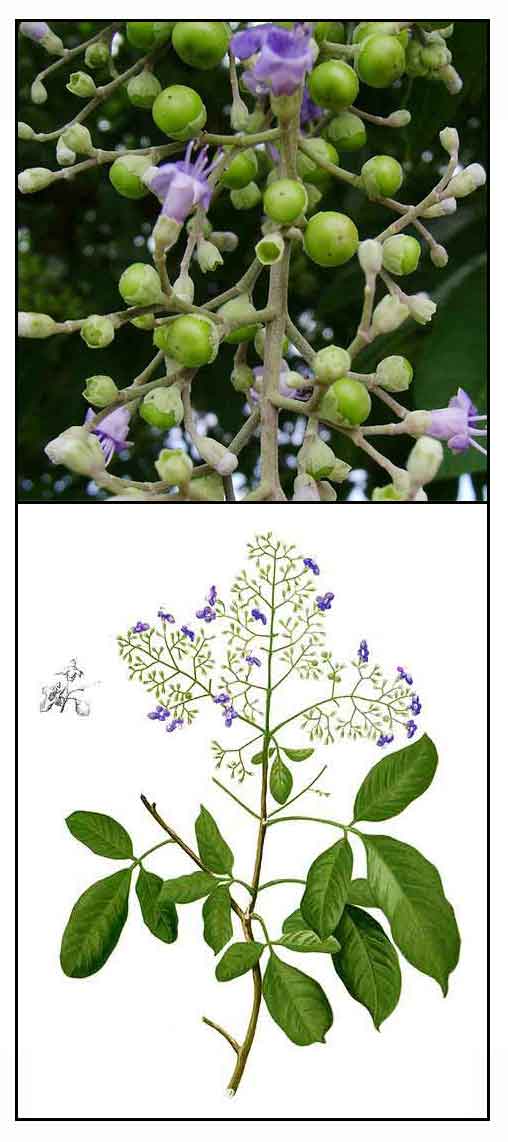
• Lagunding-dagat is a shrub or small tree growing from 1 to 4 meters high, sometimes prostate or ascending in habit. Leaves are simple or 3-foliolate. In the prostrate form, the leaves are all simple, stalkless, oblong to oblong-elliptic, 4 to 7 centimeters long, 1.5 to 4 centimeters wide, pointed at both ends, smooth and shining on the upper surface, and sparsely covered with gray hairs beneath. Flowers are numerous, borne in terminal, oblong panicles 5 to 10 centimeters long. Corolla is hairy, lavender to blue. Tube is about 8 millimeters long, the larger central lobe of the lower lip has a white blotch at the base; limb is 12 millimeters in the greatest diameter. Fruit is rounded, 4 to 5 millimeters in diameter.
• Vitex trifolia is a shrub or small tree, that reaches 1.5-5 m tall and stands erect. The branchlets are densely pubescent. The leaves are 1-5-foliolate, with petioles that measure 1-3 cm. The leaflets are sessile and oblong, lanceolate or obovate in shape. The abaxial surface is grey and tomentose. The adaxial surface is green and glabrous or subglabrous. The base is cuneate, the leaf margin is entire and the apex is obtuse. There are approximately eight pairs of veins, which are slightly prominent on both surfaces. There is a central or single leaflet which measures 2.5-9 × 1.7-3 cm. The panicles measure 3-15 cm. The peduncle is grey and tomentose. The calyx is slightly 5-dentate and is grey pubescent on the outside, but glabrous on the inside. The corolla is purplish to bluish purple, 6-10 mm in size, and scaly white on the outside. The petals are pubescent at the bases of the filaments and on inside of the lower lobe. The stamens are exserted. The ovary is glabrous, with or without glands and the style is glabrous. The fruit is black, nearly spherical and 5 mm in diameter. (Flora of China Editorial Committee) (45)
Distribution
- Native to the Philippines.
-
Along the seashore throughout the Philippines.
- Also native to Afghanistan, Andaman Is., Assam, Bangladesh, Bismarck Archipelago, Borneo, Cambodia, Caroline Is., China North-Central, China South-Central, China Southeast, Comoros, Cook Is., Fiji, Gilbert Is., Hainan, India, Iran, Jawa, Kenya, KwaZulu-Natal, Laos, Lesser Sunda Is., Line Is., Madagascar, Malaya, Maluku, Marianas, Marquesas, Marshall Is., Mauritius, Mozambique, Myanmar, Nansei-shoto, Nauru, Nepal, New Caledonia, New Guinea, New South Wales, Niue, Northern Territory, Queensland, Samoa, Society Is., Solomon Is., Somalia, Sri Lanka, Sulawesi, Sumatera, Taiwan, Tanzania, Thailand, Tonga, Tuamotu, Tubuai Is., Vanuatu, Vietnam, Wake I., Wallis-Futuna Is., Western Australia. (22)
- Often introduced as an ornamental or hedge plant, it has escaped from cultivation and has become naturalized and invasive principally in disturbed areas and secondary forests. The species is listed as invasive in Cuba. The subspecies, V. trifolia subsp. litoralis is considered invasive in the United States (North and South Carolina) where it shades native plants and disrupts nesting sites for sea turtles. (45)
 Constituents
• Study yielded 31 compounds and 28 were identified as triterpenes, fatty acids, flavones, and derivatives of benzene.
• Leaves Leaves yield an essential oil and resin.
• Fruit contains an acid resin, an astringent organic acid, malic acid, traces of an alkaloid, and coloring matter.
• Chemical studies of leaves and twigs yield an essential oil, 0.11 - 0.28 per cent. Chief constituents of the oil are l-d-pinene and camphene (55 %); terpinyl acetate (10 %); and a diterpene alcohol (20 %).
• Study isolated a new benzofuran-type lignan, vitrifol A, from the fruits of V. trifolia with three known compounds.
• Study yielded five triterpenoids: (1) ursolic acid (2), 2alpha,3alpha-dihydroxyurs-12-en-28-oic acid (3) betulinic acid (4) taraxerol, and (5) 2alpha,3beta, 19-trihydroxyurs-12-en-28-oic acid.
• Study of fruits isolated seven new labdane-type diterpenoids, vitextrifoline A-G (1-7), along with eight previously reported analogues.
(see study below) (36)
• Preliminary phytochemical screening of various leaf extracts yielded carbohydrates, flavonoids, protein and amino acids, tannins, phytosterols, and saponins. (39)
• Phytochemical analysis of methanol extract of seeds yielded alkaloids, essential oil, phenol, glycosides,
saponins, flavonoids, tannins, and terpenoids. (see study below) (44)
Properties
- Drought and salt tolerant.
-
Plant has been reported to trigger allergic reactions: sneezing, dizziness, headache, nausea.
-
Leaves considered antiseptic, anthelmintic, aromatic, febrifuge, anodyne, diuretic, emmenagogue, insecticidal.
- Fruit considered nervine, cephalic, emmenagogue.
- Roots considered tonic, expectorant and febrifuge.
- Studies have shown larvicidal, anticancer, anti-inflammatory, analgesic, hepatoprotective, anti-asthmatic, wound healing, tyrosinase inhibitory, anthelmintic, antitubercular, antiproliferative, anthelmintic, antibacterial, properties.
Parts used
Leaves, roots, fruits.
Uses
Edibility
• No reports found on edibility.
Folkloric
• For that peculiar Filipino malady characterized by an intense localized burning in the soles of the feet - quemaduras del pie o ignipedites - application of leaves 3 to 4 times daily provides relief. The leaves are heated in an earthen pot without the addition of water, then applied when sufficiently hot, and held in place by a bandage.
• Decoction of leaves used for aromatic baths.
• Emmenagogue, used in amenorrhea.
 • In Malaya, decoction of roots is drunk for fever and after childbirth. • In Malaya, decoction of roots is drunk for fever and after childbirth.
• In India, leaves used as anodyne, diuretic and emmenagogue.
Leaves in fomentations and baths used for treatment of beri-beri and burning of the feet.
• Dry fomentation of leaves used for sprains, contusions and rheumatism.
Infusions used for intermittent fevers with scanty urine, rheumatism and as febrifuge.
• In Malaya, leaves are ground with garlic, pepper, turmeric and boiled rice and made into pills and given for consumption.
• Powdered leaves used as febrifuge and antiseptic.
• Used for headache, catarrh, watery eyes, and to promote growth of the beard.
• Used in treatment of breast cancer.
• Powdered fruit, sweetened or mixed with honey, or in decoction, used as nervine, cephalic and emmenagogue.
• Leaves used internally or externally in baths to cure itching associated with Ciguatera fish poisoning.
• In Chinese medicine, dried fruit has been used for colds, headache, migraine, eye pain. In some parts of China, used as folk medicine to cure certain cancers.
• Roots used as tonic, expectorant and febrifuge.
• In India, crushed leaves mixed with ghee applied to ringworm infection. Juice collected from crushed plant is mixed with equal amount of honey, boiled, and the collected oil is filtered, and a teaspoon is taken twice daily for tuberculosis. Juice from crushed leaves applied to skin rashes. (27)
- In Samoa, leaves used for treatment of fever. Dried leaves burned for mosquito repellence.
Others
• Decorative: Flowers and seeds used in making leis.
• Repellent: Leaves are burned as insect or mosquito repellent.
• Wood: Used for fuel and for light construction.
Studies
• Vitexicarpin / Apoptosis-Inducing: In a study investigating the inhibitory effect of vitexicarpin on the proliferation of human cancer cells showed it induces apoptosis in K562 cells via mitochondria-controlled apoptotic pathway.(1)
• Larvicidal: In a study of four species of Vitex against Culex quinquefasciatus larvae, the highest larvicidal activity was found with the extract of V. trifolia. (2)
• Larvicidal: In a study of the larvicidal activity of fatty acid methyl ester extracts of V. altissima, V. negundo and V. trifolia against early fourth-instar larvae of Culex quinquefasciatus, the extract of V. trifolia showed the highest larvicidal activity. (13)
• Anti-Cancer / Antifungal: Hexane and dichloromethane extracts showed toxicity against several cancer lines in culture. The hexanic extract from the leaves completely inhibited the growth of the fungal plant pathogen Fusarium species. (3)
• Hepatoprotective / CCl4-Induced Injury: Study showed V. trifolia could provide significant protection against CCl4-induced hepatocellular injury. The hepatoprotective activity is supported by histological studies of liver tissue. (4)
• Hepatoprotective / Flowers: Study showed ethanolic extract of flowers of Vitex trifolia possess hepatoprotective activity on CCl4-induced hepatic injury in rats. The activity was comparable to standard drug, silymarin. (5)
• Anti-Inflammatory: Aqueous extract of Vitex trifolia showed significant dose- and time-dependent inhibitory activity on interleukin (IL)-1B, IL-6 and iNOS mRNA synthesis. (6)
• Wound Healing: Study on the wound healing potency of ethanol leaf extracts of V trifolia and V altissima showed both extracts to possess significant would healing potency. Of the two, V trifolia showed maximum healing activity compared to V altissima. (7)
• Anti-Asthmatic Compounds: Study of leaves of V trifolia isolated three compounds – viteosin-A, vitexicarpin and vitetrifolin-E. Vitexicarpin was the most active of the three. The mechanism of activity seems to be non-competitive antagonism to histamine and stabilization of mast cells membrane function. (9)
• Antibacterial / Leaves: Various extracts of Morinda citrifolia, Vitex trifolia (leaf) and Chromolaena odorata were evaluated for antibacterial activity. The extracts showed comparable antibacterial activity towards bacterial isolates, supporting its traditional use and suggesting a potential use for the treatment of infectious disease and development of chemotherapeutic agents. (11)
• Antinociceptive / Anti-Inflammatory / Leaves: Study of leaf extract showed significant anti-nociceptive and anti-inflammatory activity. The leaf extract potentiated the analgesic activity with pentazocine and aspirin. It showed dose-dependent anti-inflammatory activity in the carrageenan-induced paw edema model. (12) Study evaluated an aqueous extract of leaves for anti-inflammatory activity by carrageenan induced paw edema, granuloma pouch and formaldehyde induced arthritis models. Results showed significant (p<0.001) increase in percentage of inhibition of paw edema and significant inhibition of exudate formation. (26) Study evaluated leaf extracts of Vitex trifolia for anti-inflammatory activity using two models i.e., carrageenan induced rat paw edema and xylene induced ear edema in mice. Results showed significant reduction in paw volume (p<0.01) and ear edema. The alcoholic extract showed more activity than the aqueous extract and also in a dose dependent manner. (28)
• Anticancer / Vitexicarpin: Study carried out to identify anticancer components isolated 18 compounds: labdane-type diterpenes 1-6, flavonoids 7-13, iridoid, lignan, steroid, phenolic and fatty acids 14-18. Compound 9, vitexicarpin, exhibited strong dose-dependent anticancer activity. Further anticancer evaluation showed inhibitory activity of vitexicarpin on the proliferation of K562 cells. (14)
• Anti-Inflammatory Properties / Inhibition of NF-kB Translocation: Study suggested the anti-inflammatory properties of V. trifolia extract seemed associated with inhibition of NF-kB translocation through a reduction in expression of expression of NF-kB p50, and effects on inflammation mediators such as chemokines CCL-3 and CXCL-10, and COX-2. (17)
• Antibacterial / Leaves: Study evaluated two medicinal plants, Vitex trifolia and Aristolochia indica for potential bacterial activity against S. aureus, K. pneumonia, B. subtilis, E. coli, S. typhi and P. aeruginosa. A benzene extract of leaves of V. trifolia exhibited highest inhibition against B. subtilis. Phytochemical screening yielded alkaloids, flavonoids, saponins, phenolics, tannins and terpenoids. (18)
Study of crude powdered extracts of leaves of Vitex trifolia, V. negundo, and V. leucoxylon showed antibacterial activity against both gram positive and gram negative organisms viz., B. subtilis and E. coli. (32)
• Anthelmintic / Leaves: Study evaluated the anthelmintic activity of various leaf extracts of V. trifolia against earthworm Pheretima posthuma. Results showed the potential usefulness of aqueous and alcoholic extracts of V. tirifolia against the earthworm. (19)
• Antitubercular Diiterpenoids / Leaves: Study yielded a new halimane diterpenoid, 13-hydroxy-5(10),14-halimadien-6-one (1) and two new labdane diterpenoids, 6α,7α-diacetoxy-13-hydroxy-8(9),14-labdadien (2) and 9-hydroxy-13(14)-labden-15,16-olide (3). Compounds 3 and 4 (another known diterpenoid, isoambreinolide) exhibited antitubercular activity (MIC 100 and 25 µg/ml, respectively) against Mycobacterium tuberculosis H37Rv in BACTEC-460 assay. (20)
• Analgesic / Leaves: Study evaluated the analgesic potential of V. trifolia using the acetic acid-induced writhing test in mice and tail immersion method in rats. Results showed both central and peripheral analgesic potential. (21)
• Anticancer / HepG2 and HeLa: Study evaluated the cytotoxicity of n-hexane fractions of Vitex trifolia in two cancer lines: HepG2 and HeLa. Results showed VT to be highly effective against both HepG2 and HeLa cancer lines at concentration of 80 µg/ml. Findings suggest a potential for use in liver and cervical cancers. (24)
• Cytotoxicity / MCF-7 Cell Lines: Study evaluated the the cytotoxic activities of methanol and PE extracts against MCF-7 and Vero cell line. Results showed strong inhibition against MCF-7 cell lines and weak inhibition against the Vero cell line. Study suggests V. trifolia can cause cell death in MCF-7 cancer cells and has promise as a chemotherapeutic agent in breast cancer treatment. (25)
• Effect of Leaves on Acute and Subacute Inflammatory Stages: Study evaluated a hydroalcoholic extract of V. trifolia for anti-inflammatory activity in Wistar rats in acute inflammatory model using an 1% injection of homogenized carrageenan suspension and subacute study using subcutaneous implantation of pellets of compressed cotton and gross pith. The ethanolic extract of Vitex trifolia showed anti-inflammatory activity on both acute and sub-acute stages of inflammation. (29)
• Vitexilactone / Rosiglitazone-Like Effect
in 3T3-L1 Preadipocytes / Insulin Sensitizer Potential: Study has shown extracts of V. trifolia induced adipogenesis similar to rosiglitazone (EOS), a TZD, in 3T3-L1 preadipocytes. This study isolated three known compounds, vitexilactone (1), vitexicarpin (2) and oleanolic acid (3). Among the three, compound 1 showed the strongest ROS-like action. Both vitexilactone and ROS increased lipid accumulation, expression of adinopectin and GLUT4 in cell membrane and decrease both size of adipocytes and the phosphorylation of IRS-1, ERK1/2 and JNK in 3T3-L1 cells. Results suggest vitexilactone is a novel insulin sensitizer candidate. (30)
• Toxicity Studies of Combined Extracts: Study evaluated the toxicity studies of combined extracts of Vitex leucoxylon, V. negundo, and V. trifolia. On acute toxicity study done in single doses by oral route up to 2000 mg/kg crude extracts, no mortalities or evidence of adverse effects were observed in mice. Subacute toxicity study was done with oral doses of 200 and 400 mg/kg for 28 days to mice. Except for transient change in WBC count, there were no significant alterations in hematological parameters. The increase in WBC may indicate the impact of combined extracts in boosting the immune system of treated groups. No changes were noted on renal functions. Gross examination of internal organs showed normal architecture, with no detrimental changes or morphological disturbances. (31)
• Molluscicidal Activity / Leaves: Study of ethanolic extract of Vitex trifolia leaves yielded ß-sitosterol and two triterpenoids, ursolic acid acetate and platanic acid. Preliminary molluscicidal testing of various extracts was done against Biomphalaria alexandria adult snails. Of all the extracts tested, the ethanol extract was most effective and showed an LC50 of 26.42 mg/l. (33)
• Gold Nanoparticles / Antimicrobial / Leaves: Study reported on the simple, eco-friendly synthesis of gold nanoparticles using shade dried leaves of Vitex trifolia. Five leaf extracts were evaluated for antibacterial activity by disc diffusion method. The ethyl acetate extract showed strongest antibacterial effect against E. coli, Acenatobacter, Proteus, Staphylococcus, and Klebsiella. (34)
• Comparative Wound Healing Effect / Vitex trifolia and V. altissima / Leaves: Study evaluated the wound healing potential of leaf extracts of V. trifolia and V. altissima in incision, excision, and dead space wound models. Both plants exhibited significantly wound healing ability evidenced by various wound healing measures, i.e., decrease in period of epithelization, increase rate of wound contraction, skin breaking strength, granulation tissue dry weight, hydroxyproline content and breaking strength of granulation tissue and increased histological collagenation. Of the two leaf extracts, V. trifolia showed maximum wound healing activity. (35)
• Labdane-Type Diterpenoids / No Cytotoxicity Against Cancer Cell Lines / Fruits: Study of fruits isolated seven new labdane-type diterpenoids, vitextrifoline A-G (1-7), along with eight previously reported analogues. The Isolates were tested against four human cancer cell lines: All were found inactive with IC50 <5 µg/mL. (36)
• Abietatriene / Inhibition of Melanogenesis / Leaf Oil: Study of V. trifolia leaf oil isolated abietatriene and investigated its effect on melanogenesis in B16F10 melanoma cells. Results showed significant decrease in melanin contents and melanogenic factors, such as tyrosinase, TRP-1, TRP-2, and MITF dose dependently in both protein and mRNA levels. Study indicates the leaf oil and abietatriene reduces melanogenesis by regulating expression of melanogenic factors. Results suggest a potential therapeutic option for the treatment of hyperpigmentation and as skin-whitening agent. (37)
• Snake Venom Treatment / Sinduvaaraka Moola Agada / Root: Study evaluated the root of Vitex trifolia for snake venom therapy in an animal model. The root was titrated in swarasa of the same and mixed with honey. Given orally, the agada is beneficial in elapidae snake venom poisoning. It is beneficial as first aid measure as it delays the onset of symptoms in common cobra and Russel's viper venom and does not interact with Poly Valent Anti Snake Venom Serum (PVASCS). (38)
• Antigiardial / Antiamoebic / Cytotoxic / Leaves: Study evaluated the antigiardial, antiamoebic and cytoxicity of V. trifolia leaves. A petroleum ether extract showed the highest activity against Giardia lamblia with 75.25% mortality within 72 h at 1000 ppm concentration. A methanolic extract showed highest activity against Entamoeba histolytica with 61.64% mortality within 72 h at 1000 ppm. The methanol and PE extracts showed varying degrees of toxicity to Vero cell lines with IC50 of 349.07 µg/ml and 369.77 µg/ml, respectively. (40)
• Casticin / Protective in Eosinophilic Airway Inflammation and Oxidative Stress in Asthma: Casticin has been isolated from V. trifolia and found to have anti-inflammatory and anti-tumor properties.
This study evaluated the ability of casticin to reduce airway hyper-responsiveness (AHR), airway, inflammation, and oxidative stress in the lungs of a murine asthma model. Study showed casticin in a powerful immunomodulator, ameliorating changes by suppressing Th2 cytokine expression in mice with asthma. (41)
• Agnuside / Free Radical Scavenging / Leaves: Study of an ethanol extract of leaves isolated an iridoid, agnuside. On DPPH assay for free radical scavenging, ethanol extract of leaves showed an EC50 of 0.478 mg/mL, more effective than the chloroform extract with EC50 of 0.602 mg/mL. NO free radical scavenging for the ethanol leaf extract showed an EC50 of 0.524 mg/mL, more effective than the chloroform extract EC50 of 0.660 mg/mL. (42)
• Chewable Lozenges / Glycerin-Gelatin Base
/ Leaves: Legundi leaf is often used in Indonesian traditional medicinal treatment of asthma. Study evaluated an acceptable and practical alternative in the form of chewable lozenges with base glycerin-gelatin and the bioavailability of viteksikarpin in the preparation. Results showed the variation in proportion of glycerin and gelatin affected the physical properties of legundi leaf extract chewable lozenges. The higher the proportion of gelatin, the less the bioavailability of viteksikarpin. (43)
• Anitmicrobial / Essential Oil / Seed: Antimicrobial analysis of seed essential oil showed greater than 10mm zone of inhibition (MICs) against E. coli, S. aureus, S. typhi, Klebsiella pneumonia. (see constituents above) (44)
• Effect on Cytokine Production / Potential Against Immune-Mediated Inflammatory Conditions / Leaves: Study evaluated the effects of various solvent leaf extracts of V. trifolia on cytokine production in human U937 macrophages, and identify phytoconstituents from most active leaf extract. Dichloromethane extract and maceration in ethanol were most active in inhibiting TNF-α and IL-1ß production in human U937 macrophages. Further purification isolated artemetin, casticin, vitexilactone and maslinic acid. Artemetin suppressed TNF-α and IL-1ß production. Further studies are suggested to develop novel treatment strategies in immune-mediated inflammatory conditions. (46)
• Anti-Inflammatory Against H2O2 and LPS-Induced RAW264.7 Cells / Leaves: Study evaluated the antioxidant and anti-inflammatory effect of Vt leaves hydroalcoholic extract against murine macrophages (RAW264.7 cells) induced with H2O2 and lipopolysacharide (LPS). At doses of 25 and 50 µg/ml, Vt showed protective effects and significantly (p<0.05) increased cell viability and reduced ROS production. At 50 and 100 µg/mL, Vt significantly (p<0.05) reduced LPS-induced TNFα and IL-6 levels and COX activity. Significant positive correlation was noted between Vt antioxidant and anti-inflammatory effects. Results suggest potential for Vt as source of nutraceutical compounds with anti-inflammatory and antioxidant activities. (47)
• Inhibitory Activity on LPO, XO, COX, and Tyrosinase / Leaves: Leaves of V. trifolia extracted with distilled water, 1M Na2CO3 and 70% methanol evaluated for inhibitory activity on lipoxygenase, xanthine oxidase, tyrosinase, and cyclooxygenase showed inhibition percentage of 59.34, 61.23, 71.02 and 51 respectively. Values obtained with flavonoid extracts were 70.22, 81.48, 94.8, and 74.36 respectively. Inhibition properties of flavanoid extracts were greater than the alkaloid extracts. (48)
• Antiproliferative Against Cancer Cell Lines / Gamma Irradiated Leaves: Study evaluated the effect of gamma irradiation dose of 7.5 kGy treatment on dried legundi leaves coarse powder as anti-cancer and its chromatograme profile. Study on cytotoxic activity showed the irradiation dose did not damage its anticancer potential. The IC50 of legundi leaves extract before and after irradiated dose against MCF cancer cells was 8.2 increased to 12.1 µg/mL; HeLa from 7.6 to 16.9 µg/mL, and K-562 from 19.7 to 22.4 µg/mL. The efficacy of both unirradiated and irradiated leaves were in the active category anticancer potential with its IC5o of less than 30 µg/mL. (49)
• Inhibition of Mast Cell-Mediated Allergic Inflammation: Study evaluated the mast cell-mediated anti-inflammatory effect of V. trifolia and elucidated its mechanism of action. Results showed bioactive extract and fractions of VT dose-dependently inhibited PMACI-induced release of ß-hexosaminidase and change in cell shape associated with mast cell degranulation. The methanol extract and fractions 1,5, and 6 significantly inhibited PMACI-stimulated levels of intracellular Ca2+ in HMC-1 cells (p<0.05). The ME and fractions attenuated pro-inflammatory cytokine production (TNF-α, IL-6, IL-8 and GM-CSF). VTM5 (factor 5) exhibited a distinct patter of anti-inflammatory action by inhibiting the production of TNF-α, IL-6, and GM-CSF by targeting PI3K/Akt and NF-xB signaling. (50)
• COX-2 Inhibitor / Anti-Inflammatory: Study evaluated the effect of cyclooxygenase-2 inhibitory effects spectrophotometrically in ELISA readers and the anti-inflammatory activity in carrageenan-induced rat paw edema model. The ethanol extract at 200, 400, and 800 mg/kbw showed significant anti-inflammatory activity and a COX-2 inhibitory effect. The % COX-2 inhibition was 8.04%, 20.74% and 21.92%, and percentage inhibition of paw edema was 39.56%, 45.60%, and 40.56%, respectively. Results showed promising and remarkable anti-inflammatory activity, which is directed against the enzymatic activity of COX-2. (51)
• Terpenoids / Anti-Inflammatory: Study of V. trifolia isolated a new diterpenoid glucoside, (3S,5S,6S,8R,9R,10S)-3,6,9-trihydroxy-13(14)-labdean-16,15-olide 3-O-β-D-glucopyranoside (1), and a new iridoid glucoside, (1S, 5S,6R,9R)-10-O-p-hydroxybenzoyl-5,6β-dihydroxy iridoid 1-O-β-D-gluco-pyranoside (2), along with six known compounds (3-8). Compounds 2, 4, 5, and 7 showed moderate inhibitory effects on nitric oxide production in LPS-induced RAW 264.7 macrophages with IC50s of 90.05, 88.51, 87.26, and 76.06 µM, respectively. (52)
Availability
- Wild-crafted.
- Herbal formulations in the cybermarket. |