
|

Family •
Anacardiaceae
Ligas
Semecarpus cuneiformis Blanco
MARKING NUT TREE
Dun ye rou tuo guo
| Scientific names | Common names |
| Cassuvium perrottetii (Marchand) Kuntze | Agas (P. Bis.) |
| Cassuvium philippinense (Engl.) Kuntze | Anagas (P. Bis.) |
| Semecarpus cuneiformis Blanco | Hanagas (Bis.) |
| Semecarpus elmeri Perkins | Ingas ( BiK.) |
| Semecarpus ferrugineus Merr. | Kamiing (Sbl.) |
| Semecarpus lanceolatus Ridl. | Kaming (Pamp., Tag.) |
| Semecarpus megabotrys Merr. | Kamiding (Ig.) |
| Semecarpus merrillianus Perkins | Kamiling (Ting.) |
| Semecarpus micranthus Perkins | Kamiring (Ibn., Ilk.) |
| Semecarpus obtusifolius Merr. | Libas (Bon.) |
| Semecarpus perrottetii Marchand | Lañgas (Bis.) |
| Semecarpus perrottetii Marchand | Loñgas (C. Bis.) |
| Semecarpus perrottetii var. glaber Marchal | Ligas (Pamp., Tag.) |
| Semecarpus philippinensis Engl. | Pakan (Bon.) |
| Semecarpus pilosus Merr. | Ligas tree (Engl.) |
| Semecarpus ridleyi Merr. | Marking nut tree (Engl.) |
| Semecarpus sideroxyloides Perkins | Oriental cashew (Engl.) |
| Semecarpus taftianus Perkins | |
| Semecarpus thyrsoideus Elmer | |
| Semecarpus whitfordii Merr. | |
| Libas is a common name shared by (1) Spondias pinnata (2) Salix tetrasperma (3) Balbas-bakiro (Momordica cochinchinensis) (4) Ligas (Semecarpus cuneiformis). | |
| Semecarpus cuneiformis Blanco is an accepted. KEW: Plants of the World Online | |
| Other vernacular names |
| CHINESE: Dun ye rou tuo guo, Lan yu. |
| MALAY: Kutang |
|
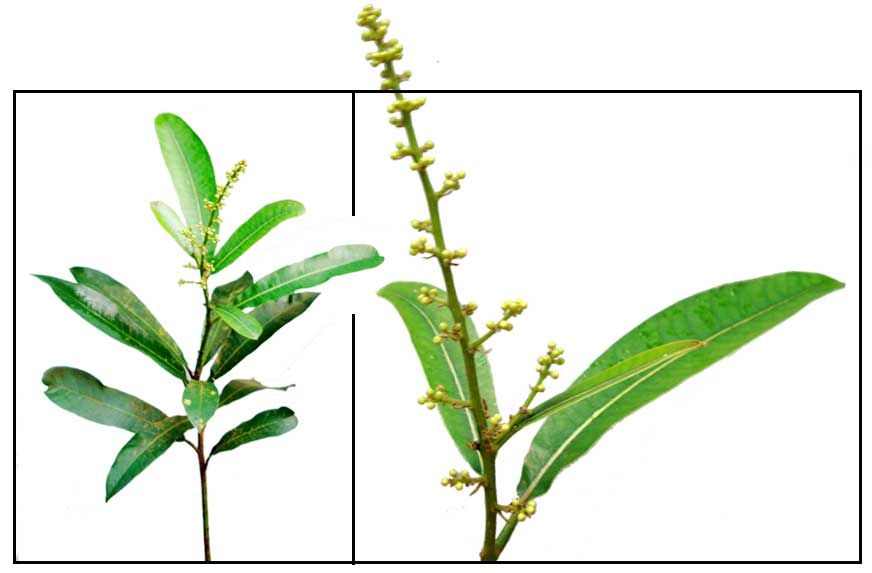
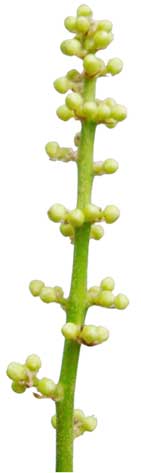
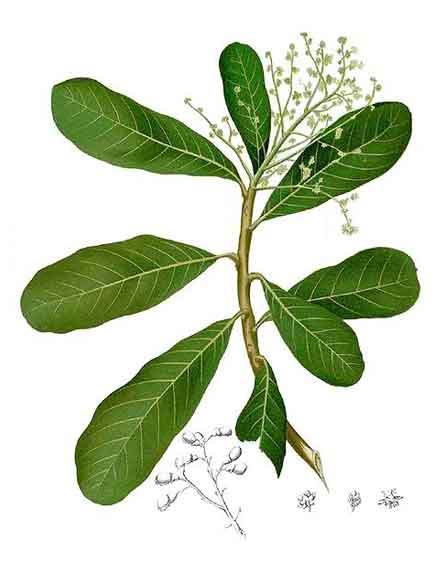
• Trees, 4-20 m tall; branchlets brownish. Petiole 1-3 cm, sparsely pubescent; leaf blade obovate-oblong to narrowly elliptic, 8-35 × 2-9 cm, leathery, adaxially glabrous to minutely pubescent, abaxially variable in hairiness from densely tomentose or pubescent to rarely glabrous, with distinct papillae except on midrib and major veins, base cuneate to obtuse, margin entire, apex variable from acute to rounded, lateral veins 11-25 pairs, prominent abaxially, reticulate venation prominent abaxially, distinct to indistinct adaxially. Inflorescence paniculate, 15-30 cm, tomentose or pubescent; floral subtending bracts 0.5-3 mm. Pedicel missing or very short; flowers greenish white. Calyx lobes broadly ovate, 0.5-1 mm, obtuse apically. Petals ovate-oblong to elliptic, 1.5-3 mm, minutely pubescent to glabrous, longitudinally veined. Stamens 2.5-3 mm; anthers ca. 0.7 mm; staminodes in female flowers ca. 1 mm. Disk round, flat, 1-2 mm across, pilose. Ovary ca. 2 mm across, densely pubescent. Drupe ovoid to broadly ellipsoid, 1-2 × 0.7-1.5 cm, apex obtuse, lower part covered by hypocarp. (Flora of China) Distribution Constituents Properties Caution ! Studies Availability |
Updated May 2024 / March 2018 / February 2015

 |
PHOTOS / ILLUSTRATIONS |
| Photos © Godofredo Stuart / StuartXchange |
| OTHER IMAGE SOURCE: / File:Semecarpus microcarpa Blanco1.75-cropped.jpg / Plate from book / Flora de Filipinas / Francisco Manuel Blanco (OSA) / Public Domain / Wikimedia Commons |
| OTHER IMAGE SOURCE: Liner Drawing / Figure 51 from Philippine Resins, Gums, Seed Oils, and Essential Oils Bulletin No. 20 / Augustus P. West and William H. Brown, Department of Agriculture and Natural Resources, Bureau of Forestry, Philippine Islands/ 1903 / Wikimedia Commons |
| OTHER IMAGE SOURCE: Semecarpus cuneiformis redolens / © all rights reserved / 張玉慧 / Image modified / Click on image or link to go to source page / iNaturalist |
Additional
Sources and Suggested Readings |
• |
DOI: It is not uncommon for links on studies/sources to change. Copying and pasting the information on the search window or using the DOI (if available) will often redirect to the new link page. (Citing and Using a (DOI) Digital Object Identifier) |
| List of Understudied Philippine Medicinal Plants |
| New plant names needed The compilation now numbers over 1,300 medicinal plants. While I believe there are hundreds more that can be added to the collection, they are becoming more difficult to find. If you have a plant to suggest for inclusion, native or introduced, please email the info: scientific name (most helpful), local plant name (if known), any known folkloric medicinal use, and, if possible, a photo. Your help will be greatly appreciated. |
• |
 |
• |
|

 Botany
 Parts utilized

