|
 Botany Botany
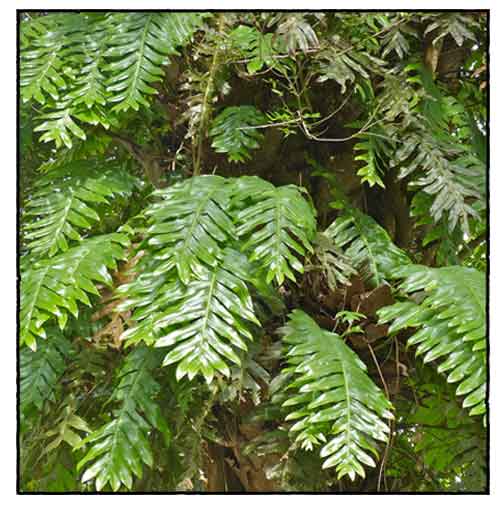
Pakpak-lawin is a large xerophyte, belonging to the fern family Polypodiaceae. Rhizome is
creeping, stout and fleshy, with narrow, brown
to blackish short-ciliate scales about 1 centimeter long. Leaves are of two kinds: cup-leaves and the fertile fronds. Cup-leaves are humus gathering fronds, brown and
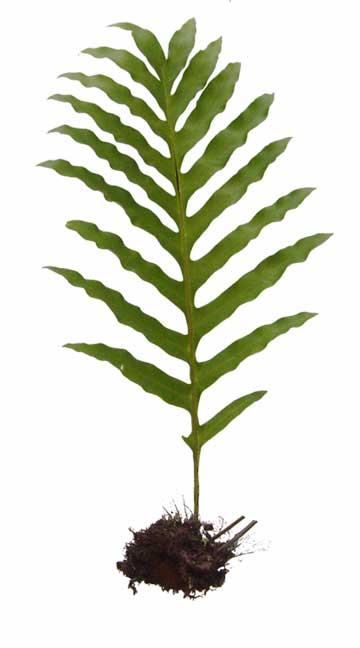
shiny when mature, ovate, coriaceous, somewhat imbricate, 15 to 30 centimeters long, 5 to 20 centimeters wide, concave, shallowly lobed below and deeply so above. Fertile fronds are long, pinnately lobed, on stipes
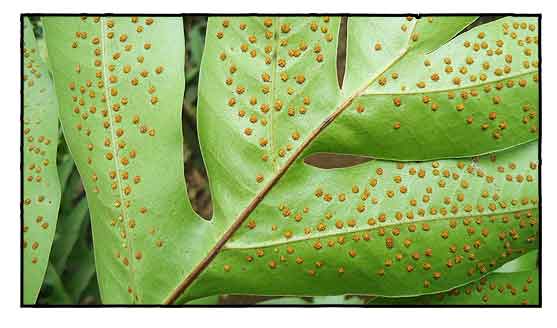
20 to 30 centimeters long. Sori are 40 to 120 centimeters in length; lobes are rather large and arranged in tow rows between the main veins.
Distribution
- Native to the Philippines.
-
Throughout the Philippines, in primary and secondary forests,
growing on rocks, trees, old stone walls.
- Also native to Andaman Is., Assam, Australia, Bangladesh, Borneo, Cambodia, Hainan, Himalaya, India, Jawa, Laos, Lesser Sunda Is., Malaya, Maluku, Myanmar, Nepal, New Guinea, Nicobar Is., Northern Territory, Queensland, Sri Lanka, Sulawesi, Sumatera, Thailand, Vietnam. (15)
 Constituents Constituents
- Phytochemical screening yielded phenols, tannins, alkaloids, proteins, xanthoproteins, carboxylic acid, coumarins and saponins.
- Yields catechin, coumarins, flavonoids, phenolics, saponin, steroids, tannins, and triterpenes.
- Study of dried rhizomes yielded friedelin, epifriedelinol, ß-amyrin, ß-sitosterol 3-beta-D-glucopyranoside and naringin. (10)
- Phytochemical analysis of fertile fronds yielded the presence of coumarins, flavonoids, glycosides, phenolics, saponins, steroids, tannins, and terpenoids. Total phenolic content was 186 mg/g equivalent of gallic acid. (see study below) (16)
- Phytochemical screening of rhizomes yielded steroids, phenolic group, catechins and tannin, with an absence of saponin and alkaloid. (see study below) (21)
- Study of petroleum ether extract of rhizome powder
yielded phytosterols and fixed oils and fats. Chloroform extract yielded sterols; a methanolic extract yielded alkaloids, sterols and tannins; and a water extract yielded tannins, proteins, amino acids, carbohydrates, gums, and mucilage. (22)
- Phytochemical screening of ethanol extract of rhizome yielded glycosides, tannins, alkaloids, flavonoids, steroids, triterpenoids, carbohydrate, amino acids and proteins. GC-MS analysis of the ethanol extract of rhizome yielded 11 bioactive compounds, the dominant compounds was 2-myristynol-glycinamide (22.502%) and lowest was 6-amino-5-cyano-4-(3-iodophenyl)-2-methyl-4H-pyron-3-carboxylic acid ethyl ester (4.505%).
(30)
Properties
- Studies have suggested antibacterial, antipyretic, antioxidant, anti-inflammatory, analgesic, anti-dermatophytic, CNS depressant, pesticidal, anthelmintic, repellent, hepatoprotective, antimicrobial, hypolipidemic, anticancer, anti-osteoarthritic , thrombolytic, membrane stabilizing, antidiabetic properties.
Parts utilized
Rhizomes and leaves.
 Uses Uses
Folkloric
· Decoction of fresh or dried rhizome for hemoptysis.
· Used
as an astringent or antihelmintic.
· Decoction of rhizome used for fever.
· The leaves are used as poultices. Also used for dyspepsia,
phthsis and fever.
· In traditional Chinese medicine, rhizomes used to promote hair growth, cure baldness and treat hyperthyroidism.
· In Bangladesh, rhizomes used in the treatment of excited mental disorders. Mixed with the plant Asparagus racemosus, applied to the head for calming effect and to reduce hair loss.
· In Thai traditional medicine, used as diuretic.
· In Tamil, Nadu soup prepared from rhizomes is popular among tribes for relief of rheumatic complaints.
· In Ayurvedic medicine, used to stimulate appetite, relieve flatulence and as general tonic.
· In India, paste of macerated rhizomes applied externally to hasten wound healing. Hot aqueous extract of rhizomes drunk to relieve cough and as expectorant, Dried rhizome powder taken internally to cure impotency. Rhizome macerated with cow's milk used to relieve renal colic pain. Macerated rhizome paste applied on scalp to treat baldness and falling hair. (29)
Studies
• Antibacterial: Study of extracts of DQ showed high efficiency of antibacterial activity, especially to Gram negative bacteria. (1)
• Anti-gonorrheal: In preliminary studies on activity of Ocimum sanctum, Drynaria
quercifolia, and Annona squamosa against Neisseria gonorrhea, D. quercifolia showed activity against N gonorrhea
comparable to penicillin and ciprofloxacin. (2)
• Antipyretic / Rhizomes: Study of the extracts of rhizomes of D. quercifolia in rabbits showed antipyretic activity with significant reduction of elevated body temperature, comparable to aspirin.
(3)
• Antioxidant: Study of a methanolic extract of powdered rhizome of Drynaria quercifolia by DPPH assay showed it to be an effective antioxidant compared to other extracts, with significant activity compared to standard drug. (4) In a study screening fifteen fern species for antioxidant activity, Drynaria quercifolia was one of five that showed antioxidant properties with strong DPPH radical scavenging activity, ferric ion reducing power, and inhibition of lipid peroxidation. (9)
• Anti-Inflammatory / Analgesic: Study of the ethanolic extract of the rhizome of D. quercifolia on Wistar rats showed potent anti-inflammatory and analgesic activity comparable to
indomethacin, sodium salicylate and aspirin. Results justify its use for alleviating painful inflammatory conditions. (5)
• Antidermatophytic / Rhizomes: Study was done on the dermatophytic activity of four rhizome extracts from D. quercifolia against T. mentagrophytes, M. canis, T. rubrum and e. floccosum. Results showed the ethyl acetate extract contains triterpenes and coumarins which may be the compounds responsible for the antidermatophytic activity of this plant.
(6)
• Antibacterial / 3,4- dihydroxybenzoic acid / Rhizome: Study isolated 3,4- dihydroxybenzoic acid from the rhizome of D. quercifolia which showed significant antibacterial activity against four gram-positive and six gram-negative bacteria. (7)
• CNS Depressant Effect: Study in mice of ethanol extract fractions of rhizome of D. quercifolia showed a dose-dependent depressant effect. (13)
• Antibacterial / Dried Rhizome: Study of dried rhizome yielded friedelin, epifriedelinol, ß-amyrin, ß-sitosterol, ß-sitosterol 3-beta-D-glucopyranoside, and naringin. The methanol extract showed broad and concentration-dependent antibacterial activity. (10)
• Antibacterial Efficacy Against Urinary Tract Pathogens: Various extracts were tested for antibacterial activity against clinically isolated urinary tract pathogens. An acetone extract was effective against Enterococcus faecalis and Streptococcus pyogenes while an ethanol extract was effective against Pseudomonas aeruginosa. (11)
• Antihelmintic: Study evaluated the anthelmintic potential of D. quercifolia against adult earthworms and piperazine citrate as standard. Results showed anthelmintic potency of the extract, inversely proportional to the time taken for paralysis and death of the worms. (12)
• Antibacterial / Cytotoxicity: Various extracts were tested for antibacterial activity and cytotoxicity. Results showed antibacterial activity against four gram-positive and six gram-negative bacteria. Extracts showed cytotoxicity using brine shrimp lethality bioassay.
• Ameliorative Effect in Rheumatism: Study evaluated the anti-arthritic effect of a rhizome water extract. Results showed reduction of paw thickness and elevation of mean body weight of arthritic rats, with significant reduction of plasma and liver lysosomal enzyme and levels of serum pro-inflammatory cytokines (TNF-α and IL-1ß and increment of anti-inflammatory cytokine (IL-10) with treatment. (14)
• Antioedematous / Analgesic / Fertile Fronds: Study evaluated the antioedematous, antiproliferative, and analgesic properties of ethanolic extract of fertile fronds of D. quercifolia. There was significant inhibition of carrageenan and histamine induced paw edema in Wistar rats. The fertile fronds significantly attenuated acute and delayed phased of formalin induced pain, acetic acid-induced writhing, capsaicin-induced nociception, and hot plate test in mice. (see constituents above) (16)
• Pesticidal / Repellent / Tribolium castaneum: Study of a chloroform fraction of D. quercifolia rhizomes extract showed significant pesticidal and pest repellency activities. (17)
• Hepatoprotective: / Fronds: Study of a hydroalcoholic extract of D. quercifolia fronds, its fractions, and isolated compound (Dq-r) on carbon tetrachloride induced hepatotoxicity showed significant dose-dependent hepatoprotective activity. (18)
• Antidiabetic / Hypolipidemic: Ethanolic and chloroform extracts of Drynaria quercifolia rhizome in STZ-induced diabetic rats showed significant antidiabetic and hypolipidemic property. Glibenclamide was used as reference standard. (19)
• Antioxidant / Cytotoxic / Antimicrobial / Rhizomes: Study evaluated various extracts from sun-dried rhizomes for antioxidant, cytotoxic, and antimicrobial activities of whole plant of D. quercifolia. Results showed very potent anti-oxidant activity by DPPH assay, mild antimicrobial activity, and cytotoxic potential using brine-shrimp lethality bioassay. (20)
• Antimicrobial / Rhizomes: Preliminary phytochemical screening yielded steroids, phenolics, catechins and tannin. Ethanolic extract of rhizomes showed antifungal and antibacterial properties. (21)
• Bone Regenerative / Treatment of Periodontal Intrabony Defects: Study evaluated the effect of Drynaria quercifolia rhizome extract as bone forming substitute in periodontal intraosseous defects. Study involved twenty patients with chronic periodontitis with intraosseous defects. Control group was treated with open flap debridement (OFD) while the treatment group had OFD and placement of drynaria plant extract. Probing pocket depth reduction (PPD) and relative attachment level gain after six months were more for the treatment group, the difference statistically significant. Results suggest the rhizome extract has potential regenerative effect on bone cells; one of the effect probably mediated by an effect on osteoclast attachment. (23)
• Anti-Ulcer / Leaves: Study evaluated ethanol extract of leaves of D. quercifolia for anti-ulcer activity against pylorus ligation and ethanol induced ulcer models in experimental rats. Results showed significant (p<0.05) reduction in gastric volume, free acidity and ulcer index. The antiulcerogenic activity was attributed, possibly, to its antisecretory activity. (24)
• Cataractostatic Activity / Tuber: Study evaluated the cataractostatic activity of methanolic and ethyl acetate extracts of Drynaria quercifolia tuber as a prospective treatment for lens cataracts using a glucose-induced cataract in isolated goat lenses in an in-vitro model. Results showed the EA extract of tuber was able to inhibit cataractogenesis. Study results suggest a potential cataractostatic agent to prevent diabetic cataract. (25)
• Membrane Stabilizing / Antioxidant / Thrombolytic / Rhizomes and Fronds: Study evaluated methanol extracts and fractions of dried rhizomes and fronds for membrane stabilizing, antioxidant and thrombolytic activities. ME of rhizomes and aqueous fractions showed potent DPPH and ABTS radical scavenging activity. Crude ME of rhizomes and fronds showed effective stabilization of erythrocyte membrane in hypotonic solution. ME and aqueous fraction of rhizomes showed noticeable clot lysis. (26)
• Synergism with Antimicrobials: Study evaluated the antimicrobial effect of an ethanol crude extract
of D. quercifolia rhizome against Staphylococcus aureus, S. epidermis, Pseudomonas aeruginosa and Eshcerichia coli. The crude extract alone did not show any zone of inhibition. However, a synergistic effect was observed when used with ampicillin and oxytetracycline against S. aureus. In vivo testing in Sprague-Dawley rats also showed the same synergistic effect with p-value of 0.047. (27)
• Anti-Inflammatory / Anti-Rheumatoid / Rhizomes: Study evaluated a methanolic extract of rhizome for anti-inflammatory and anti-rheumatoid properties. In-vitro results showed significant (p<0.05) anti-inflammatory activity in a dose-linear response. ME significantly ameliorated rheumatoid arthritis as evidenced by inhibition of arthritic paw-edema in rat rheumatoid arthritis models. Treatment also significantly (p<0.05) normalized hematological and biochemical parameters. GC-MS analysis of DME revealed presence of 47 phytochemical compounds, of which squalene, gamma tocopheral, n-hexadecanoic acid showed potent COX-2, TNF-α, and IL-6 in docking analysis. Results showed potent anti-inflammatory and anti-arthritic activity with inhibitory activity of bioactive compounds of target inflammatory markers COX-2, TNF-α, and IL-6. (28)
• Antidiabetic / Cytotoxicity against HepG2 (Liver Cancer) Cell Line / Rhizomes: Study evaluated the in vitro antidiabetic and cytotoxic potentials of rhizome extract of D. quercifolia. In On alpha-amylase inhibition assay and glucose uptake assay, the rhizome extract sowed significant antidiabetic activity. In MTT assay, significant cytotoxicity effect was observed measuring percentage cell viability on HepG2 cell line. (31)
• Anticancer / Cytotoxicity / Anti-Osteoarthritic: Study evaluated the cytotoxicity activity of Drynaria quercifolia against SAOS2 cells using methanol, ethanol, and aqueous extracts. MTT assay showed a very significant decrease in cell viability. A 50% toxicity was observed with only 25 µg/ml of MeOH extract and H2) extract at 24 hours. Maximum toxicity was observed in Saos2 cels with 250 µg/ml of all extracts at 24 h. IC50s were compared with positive control doxorubicin drug:
Availability
Wild-crafted.
Ornamental cultivation. |


_(8082752246).jpg)
_sporangia_2.jpg)



_sporangia_2.jpg)